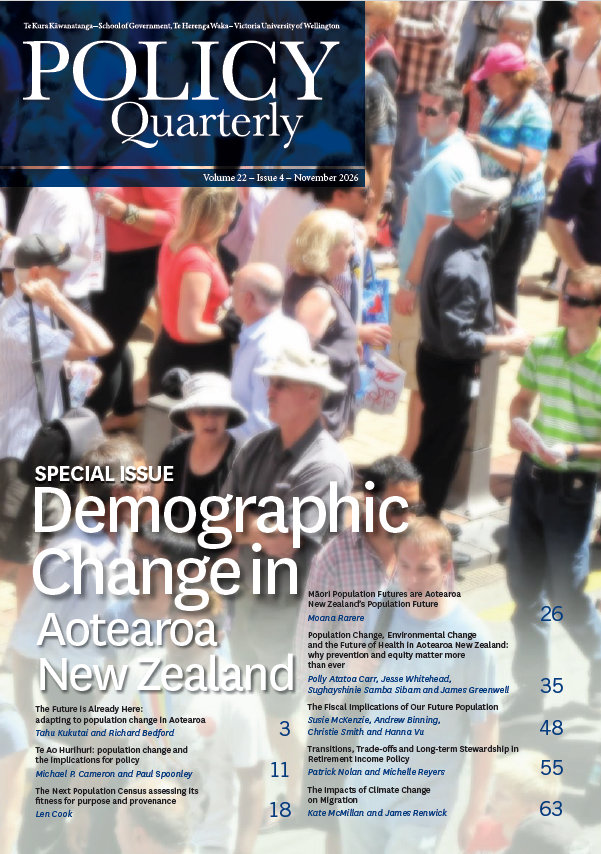
Te Ao Hurihuri: population change and the implications for policy
DOI:
https://doi.org/10.26686/2ss3mf14Keywords:
demographic change, sub-replacement fertility, ageing, regions, immigration, population growth, population declineAbstract
New Zealand is undergoing a long-term demographic transition characterised by low mortality, declining fertility, population ageing and an increasing reliance on immigration for population growth. These trends extend well beyond the ageing of the baby boomer generation and are increasingly evident at the subnational level. Immigration has also contributed unevenly to population growth and increasing ethnic diversity. Consequently, regions and centres face increasingly divergent demographic futures, ranging from continued growth to stagnation or decline. We argue that this heterogeneous demographic landscape requires a major policy rethink, as many current assumptions and delivery models reflect outdated 20th-century demographic circumstances.
Downloads
Published
Issue
Section
License
Permission: In the interest of promoting debate and wider dissemination, the IGPS encourages use of all or part of the articles appearing in PQ, where there is no element of commercial gain. Appropriate acknowledgement of both author and source should be made in all cases. Please direct requests for permission to reprint articles from this publication to Policy-Quarterly@vuw.ac.nz.